
By John Helmer, Moscow
@bears_with
Alive or dead, US Air Force (USAF) Major Amanda Ryder has just destroyed President Donald Trump’s future.
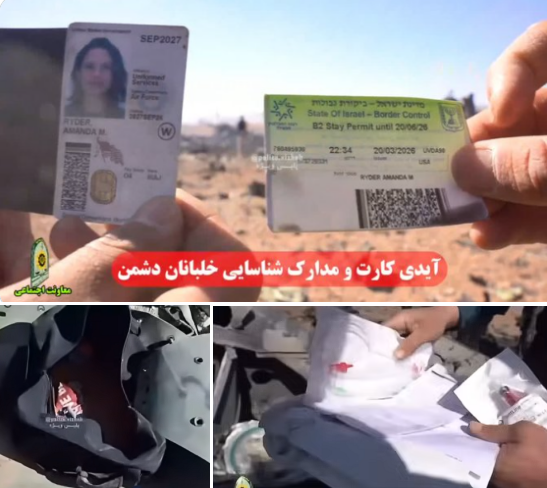
The document bag (lead image, bottom left) and documents (right) which the Iranian Law Enforcement Force (Faraja) has disclosed and published in the last twenty-four hours, are evidence of the weekend firefight and destruction of at least four US aircraft at a desert location near Isfahan, central Iran. The cache reveals top secret operational details, location maps, time logs, local intelligence sources, and objectives of a joint US-Israeli plan which was already in motion before the attack on Iran was launched on February 28.
President Trump’s public version of the mission is that it was to rescue the USAF colonel and weapons officer who had survived the earlier shooting-down of his F-15. Trump’s official calendar for the Saturday and Sunday, April 4-5, reveals that he remained in Washington instead of taking his usual weekend in Florida, but the record of his activities is unusually empty – until early on Sunday afternoon when Trump revealed by tweet that “we have rescued the seriously wounded, and really brave, F-15 Crew Member/Officer”; and then next morning: “WE GOT HIM! My fellow Americans, over the past several hours, the United States Military pulled off one of the most daring Search and Rescue Operations in U.S. History”.
Follow where Trump was and what he said in this analysis.
Teheran has announced that Ryder’s initial mission had been for an attack on Iranian nuclear facilities in and around Isfahan, to capture stocks of enriched uranium and to destroy the enrichment plant and its personnel at the same time.
There has so far been no statement from the Pentagon or the USAF corroborating the identity, whereabouts, or condition of Ryder.
Independent open-source investigation, however, confirms that on May 9, 2014, Amanda M. Ryder received her Reserve Officers’ Training Corps (ROTC) commission as a second lieutenant in the USAF. Her home was recorded as in Vienna, Virginia, although at the time she was studying at the University of Nebraska, Lincoln. In July 2023 she was nominated for promotion to major and this was confirmed by the US Senate on July 27, 2023. Her paygrade as a major was O4.
The military identification card (lead image, top left) which has been displayed in Iran as Ryder’s is the standard form of the Geneva Conventions Identification Card. The name, rank, and paygrade displayed are standard. The lack of an issuance date at bottom, the placement of the expiration date at top, and the absence of the USAF logo differ from the standard.
Details of Ryder’s age, her family home in the Greater Washington area, and her attachment to the Air Force suggest that she may be the daughter of Major General Patrick Ryder whose long career in the USAF culminated in his posting as the Defense Department Press Secretary and Pentagon spokesman between 2022 and 2025. There is no official confirmation of the relationship.
If the identification of Ryder and authentication of the visible documents are proved, then they have enormous political significance. The Israeli B2 visa card (lead image, top right), issued for Ryder’s entry on March 20, 2026, and expiring on June 20, reveals that Ryder was based in Israel prior to the Isfahan mission; she may have flown from Israel into Iran for the weekend operation. This confirms the close coordination in operations between the US and Israel.
It reinforces the likelihood that Ryder’s mission – along with the multiple special forces units which she was flying into the Isfahan desert landing site – was in planning from as early as March 20, her arrival date in Israel – and most likely for at least a month before then. However, if the operation’s objective was to launch a surprise attack on the Iranian nuclear facilities in and around Isfahan, then its failure is likely to have motivated Trump’s escalation threats which have followed.
In retrospect, it now seems likely that Trump was following the operation from the White House Situation Room through most of the day and night of Saturday and on Sunday morning. The losses of Ryder’s aircraft, another C-130 transport and two (possibly three) AH-6 Little Bird helicopters, the substitution of evacuation aircraft, the combat, and the final rescue of the F-15 pilot are likely to have created enormous tension and fear of failure for Trump and his associates. They had reason to believe they were facing an even more catastrophic Iranian desert rescue mission as had been attempted by President Jimmy Carter in May 1980.
The political consequences of a repeat of Carter’s failure for Trump would have been dramatically obvious.The faction of White House officials and military officers who have been warning Trump against escalation of the war – Vice President JD Vance, Chief Staff Susan Wiles, Counsel David Warrington, pollster Tony Fabrizio – is likely to have reinforced their urging to Trump to get out of the war as quickly as possible, with a negotiation for smokescreen.
The faction in favour of escalation – Stephen Miller, Steve Witkoff, Jared Kushner and Benjamin Netanyahu – would have reinforced their urging to escalate, ignore the negotiations with the Iranians through the Pakistan intermediary, and prepare for the use of tactical nuclear weapons.
View now or listen to this analysis of Trump as he crosses the last of his warfighting, genocide-aiming red lines.
(more…)